Friday, May 1, 2020

Google Classroom


Check your email and our Google Classroom each week for updated weekly learning plans.

Monday, April 13, 2020

Math Game - Add Three Numbers


Grade 1 and 2 Learning Tasks: Week: April 14th– 17th

Grade 1 and 2 Learning Tasks: Week: April 14th– 17th (Easter Monday is a PD day so we have not planned activities for this day.) 
The days and activities are guidelines that you can follow if you’d like; however, each day choose as many or as few options as you have time for. 

We will be providing lessons on the writing tasks on Wednesday during our 12pm meeting time online. Your child can work ahead if they chose; the lesson on Wednesday will be related to creating Acrostic Poems. Please ensure your child has their writing book, pencil, and eraser on Wednesday 
On Tuesday and Thursday this week we will be working through some math lessons and introduce Google Classroom. Your child can have his/her math book, pencil and eraser prepared for these days between 12pm-1pm. 
Our math games will stay on our blog if you want to refer back to previous posts to change up the math games you’re playing together. 

Tuesday, April 7, 2020

Making Math Resources At Home


Making Math Manipulatives (TOOLS) at Home

Hello Parents, 

Today during our afternoon whole class math meeting.  I showed some homemade tools or manipulatives to help us solve math problems.  

Children's Tasks:

1. Make a list of materials they can make math tools with (that they have at home)
2. Look at this blog with you for ideas
3.  Make some math tools (a set of objects and tens and ones)
4. Take a picture of their math tools they make and post to IRIS account

Addition and Subtraction materials

Paper and pencils (markers make it more fun sometimes) are the core way to record our ideas in math.  To help think through problems at a young age, manipulatives or math tools are very helpful.  

When working with small numbers (addends less than ten ie.  4+5=___or 9-6=____ just having sets of objects is helpful
-buttons
-beads
-seeds
-blocks
-pennies

Creating a ten frames for these objects can be helpful.  You can print these examples, draw some or you can cut off two "holes" from an egg carton.  

These are very helpful, for children to visually create "ten" and see what is "left over". 

We have class sets of these little cards and use them to play games in the class.  Regular playing cards work well too, but having a copy of these for reference can be helpful. 

TWO DIGIT NUMBERS

Many children are working on Static (without regrouping) and Dynamic (with regrouping) Addition and Subtraction with 2 digit numbers. 

In the classroom the children use golden beads (or base ten blocks to help them visualize the process.  

These blocks help us "see" place value:  our units(ones), groups of ten, groups of hundred........

You can create units and tens in many ways:

-draw a line for tens and a dot for units
-lego ten strips and singles for units
-stack 10 lego blocks and single blocks for units
-group 10 popsicle sticks with an elastic band and use singles
-string 10 beads on pipecleaners and singles for units
-gluing 10 beans or buttons on a cardboard strip or popsicle stick with single beans as units


For younger math learners, physically seeing the ten (like in the case of the beans on the stick),  is more concrete, than a long stick of cardboard representing 10. 

I have put my math tools in a tupperware to keep track of them.

NUMBERLINES and hundred charts are also a helpful tool for adding and subtracting.  


You can make simple number lines on paper or tape, or you can use a ruler or tape measure.

Generating Questions: Teachers will be creating questions for students, however students can create their own problems by using:
-dice
-spinners
-playing cards
-real life information (I have 12 stuffies, 5 are bears, how many are not bears. 12-5=_____)


Once your child has made their math tools.  You can get them to make different 2 digit numbers with them.    
ex. 
-Make 52 with your tens and ones.
-Make 12 with your ten frames and ones
-Add your sister's age and your age together with your ten frames and ones. 


Friday, April 3, 2020

Weekly Learning Plan - April 6-9


Grade 1 and 2 Learning Tasks: Week: April 6th– 9th  
(Friday is Good Friday so we have not planned activities for this day.)

The days and activities are guidelines that you can follow if you’d like; however, each day choose as many or as few options as you have time for.

We will be providing lessons on the writing tasks on Monday and Wednesday during our 12pm meeting time online. Your child can work ahead if they chose; however, the lesson on Monday will be related to creating lists and the lesson on Wednesday will be about writing an imaginative narrative. Please ensure your child has their writing book, pencil, and eraser on Monday and Wednesday. 

On Tuesday and Thursday this week we will be working through some math lessons. Your child can have his/her math book, pencil and eraser prepared for these days between 12pm-1pm.


Day 1
Day 2
Day 3
Day 4
Reading
Students in both grade 1 and 2 have worked hard on developing their reading stamina.
They are able to independently read for 20 minutes every day. We call this Read to Self. They are also accustomed to reading to a partner for 20 minutes every day. We call this Read to Someone.
You can access Raz Kids (online books) to do these reading tasks or choose reading materials from around the house.
It is important that each student is spending some time everyday reading to themselves and to someone else (even if that someone else is a stuffy, as long as they are practicing reading aloud).
Your child will meet with his/her guided reading teacher online during his/her schedule time in the morning. The guided reading teacher may assign reading tasks for him/her to complete.
Word Work/ Spelling
Copy words in a list and then write them in alphabetical order.
Grey Group: made, over, down, did, only

Blue Group: good, new write, our, me

Green Group: put, different, between, name, should

Yellow Group: brain, snail, bait, braid, train
Write the words in word stairs

Example of stairs:
t
th
the
Write each word in a sentence.

Challenge: how many of your word work words can you write in one sentence? Remember: your sentence must make sense!
Choose one way to make your five words of the week:
-  Find a stick and write the words in the mud or dirt
-  Gather sand or shaving cream or sugar/jello packets and use your finger to write the words
-  Use plasticine/playdoh to write the words (with your finger or a toothpick or a stick) or shape playdough into letters to form the words
-  Using magnetic letter, plastic letters, foam leters, create your words
Writing
Brainstorm a list of things to do around the house and/or outside. Create list of these things (add drawings to the list).
This weekend some people may be celebrating Easter. Eggs are often used in Easter celebrations. Many animals come from eggs (turtles, birds, fish). Imagine you found an egg with something special inside. What does your egg look like? What comes out of your egg? You can use your imagination to create whatever you like.


Math
Math Game: Double Dog Dare

See separate blog post for instructions on how to play this addition math game.

Math Game: I spy

See separate blog post for instructions on how to play this addition math game.


Math Games - April 6th - 10th


Word Work Groups

Our word work groups remain the same as in the classroom. Students work with the words within their group, as these are a continuation of what we've been doing in class. If you want to work with all the words, feel free to expand your workload.
We do one small word work task every day as part of our work period. This is job that students should be able to do completely independently. Refer to their word work/language work books to see how they have organized their work previously.
Some students may require help to set up the word stairs. Writing sentences and alphabetizing the words is an extension to what we've done in class so for the first week, students may want some guidance.

Grey Group: 
Ethan
Kinsley
Reid
Raphael
Ella

April 6th - 9th words of the week - made, over, down, did, only 

Blue Group: 
Avani
Natalie
Maelle
Toby
Ascher
Summer
Noelle

April 6th - 9th words of the week - good, new write, our, me 

Green Group: 
Rihansh
Zackary
Micah
Autumn
Briauna
Kelsie

April 6th - 9th words of the week - put, different, between, name, should 

Yellow Group:
Anhad
Parsa
Haruto
Leyah
Nowellia
Ethan W.

April 6th - 9th words of the week – brain, snail, bait, braid, train

Thursday, March 19, 2020

Learning updates

Hi Families,

Tomorrow you will be receiving an email from Mrs. Halsall or Mrs. Wacker about your child's learning progress at this point in the school year. If you do not receive an email by end of day tomorrow (Friday), please reach out to one of us.

Over the next week, it's important we take this time to rest and relax like we would have on a regular March break. At the end of the month we hope to have more direction and answers about all our futures. Right now, let's focus on what's important - staying healthy and enjoying our time with our family... and if you have some time, read with one another :)

We miss all of you already and hope you enjoy a well-deserved March break.

A message from Ms. Nair:

A message from Ms. Nair:

Hi Students! I miss you already! I’m glad you are all safe at home. I hope you take some time to play with your family, read lots of books and listen to your favourite music. Feel free to send me an email anytime telling me about what you’re doing and how you’re doing. I’d love to hear from you, and I’ll definitely respond. See you all soon!

Love,

Ms. Nair

Tuesday, March 17, 2020

Student belongings can be picked up tomorrow


 Hello CJP families,
Please see in the schedule below the pick-up times for you to pick-up your child’s personal belongings and return library and home reading materials. 
We have divided the pick-up times into several sessions to assist with social distancing. We respectfully request that only ONE parent enter the school to reduce the number of people visiting the building. We recommend that children stay home as this will likely be a difficult time for them to remain a safe distance away from peers and friends, however, this remains a parent decision as we are not allowed to restrict student access to the building for belonging pick-up.  
Please bring a backpack or shopping bag as most children have many items that will need to be taken home.Please do NOT take the bin holding your child’s items.  All lost and found items will also be in the gym.
If your child has medication stored at school, please check in with the teacher who will be at a table in the hall. They will be able to provide you with your child’s medications.
If you are unable to pick-up at your scheduled time, please plan to pick-up in the additional times scheduled.
If you are only dropping off library books and home reading materials, a bin will be located at the front entrance for these items. Personal items (Inside Shoes) not picked up will remain at the school for pick-up when school resumes. School work remaining will be recycled.
Please plan to enter through the unlocked front doors and proceed directly to the gym where all belongings are located. We ask that you exit through the gym doors (south or east). 
Thank you

First Letter of Student’s LAST name
Date and Time
A, B
Wednesday, March 18, 8:00 – 8:30 AM
C, D, E
Wednesday, March 18, 8:45 – 9:15 AM
F, G, H
Wednesday, March 18, 9:30 – 10:00 AM
I, J, K
Wednesday, March 18, 10:15 – 10:45 AM
L, M, N
Wednesday, March 18, 11:00 – 11:30 AM
O, P, Q, R
Wednesday, March 18, 11:45 – 12:15 PM
S, T
Wednesday, March 18, 12:30 –  1:00 PM
U, V, W, X, Y, Z
Wednesday, March 18, 1:15  – 1:45 PM
Additional Time
Wednesday, March 18, 2:30- 3:30 PM
Additional Time
Wednesday, March 18, 4:00 – 5:00 PM

Friday, March 13, 2020

Landmarks in Calgary


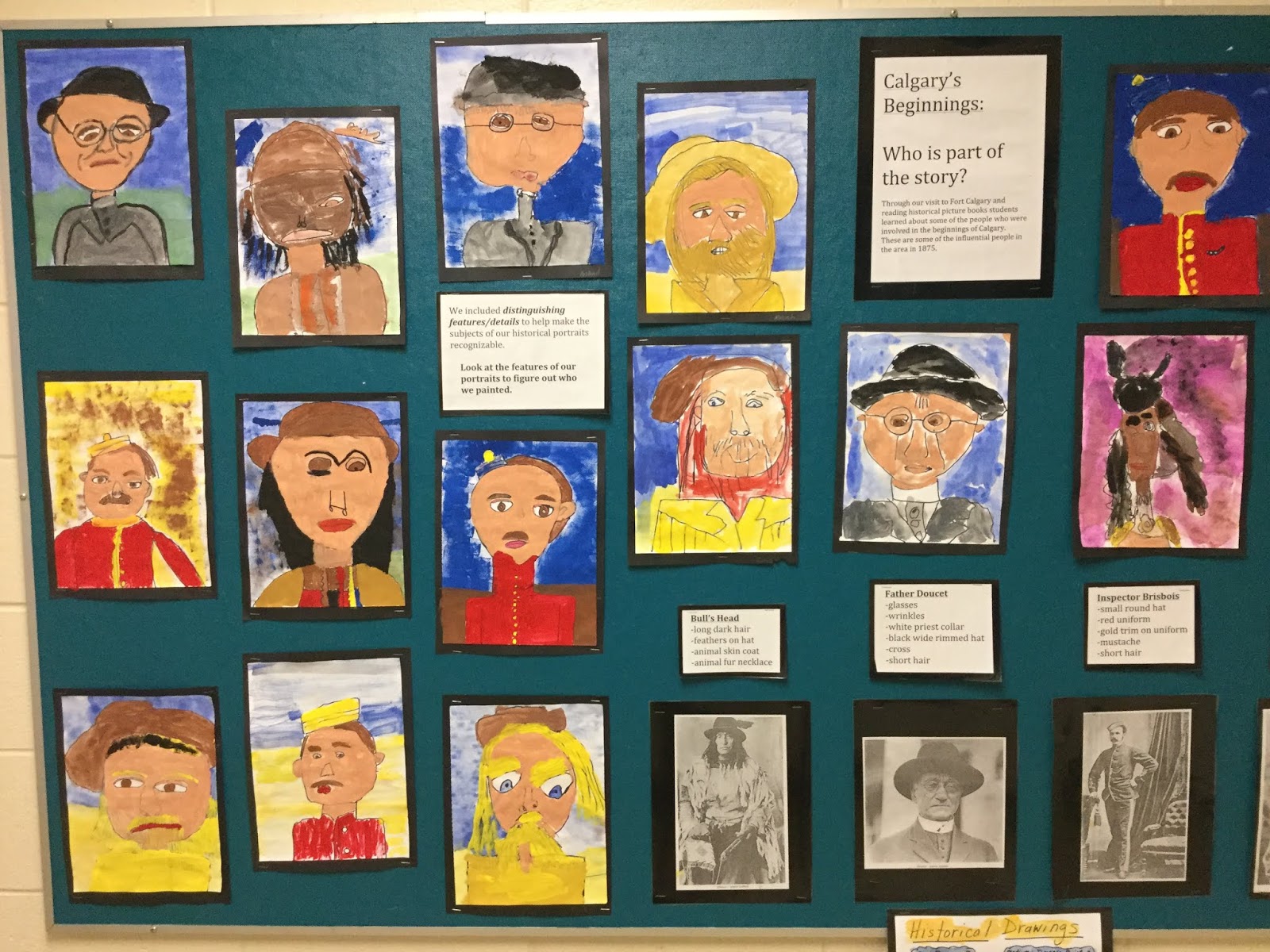
Today we talked about how our houses and communities are within the city of Calgary.  We discussed how a city was different from a neighbourhood.  Then we talked about some of the places that make Calgary unique.  Most cities have lots of big buildings, stores, universities, parks and stadiums.  We talked about what a landmark was.  A place that is easily recognizable and helps us know where we are.  We imagined Calgary and its landmarks, discussed them and looked at many pictures.  Talk about some Calgarian landmarks with your child. 

Since we are not having parents visit the school for interviews, here is the amazing art the children did for our Social Unit on Calgary's past.  


Thursday, March 12, 2020

Read to Someone


Students in grade 1 and 2 are constantly developing their reading skills. Read to Someone is an activity that students take part in every day. This involves sitting with a partner and quietly reading aloud their books that are the just right level. This activity helps students develop their fluency skills and their comprehension skills. At home, you can help develop these skills by reading aloud to your child and having them read aloud to you. It's also important that you're talking about books: retell stories, make personal connections, talk about the characters, anything else you can think about to allow your child to develop a deeper understanding of the books you read together.

Wednesday, March 11, 2020

Basic Facts Assessment- FROM Last week!

Oops, this did not publish last Wednesday.  Better late than never.

The children brought home a basic facts assessment they did last week.

If it looks like a rainbow, the kids were testing out a strategy.  We don't use the same strategy for all facts.  If the child knows their facts well, they started at the top left corner and answered the questions down the row.  HOWEVER, we discussed that if we come across a fact we don't know....we did not want to get struck.   (note parents: we should not be giving kids questions to practice if they do not have a strategy to solve it.  Practice the facts they know a strategy for.  We do not want kids practicing adding on large numbers).

This is a common test taking skill.  When stuck, kids practiced looking for facts groups they KNOW and are confident with.  Most kids first looked for adding 0 facts.  ie.  0+4=, or 8+0=.  They identified (by colouring them a particular colour) and then solved all of these facts. Then they thought of another strategy family they knew well like: COUNTING ON strategy.  It is only efficient to count on 1 or 2, so kids coloured +1 and +2 facts a different colour. ie. 5+2=, 1+7=

Some kids just coloured everything pretty randomly, but they begun to think about looking for facts in fact strategy families.....
others include:
-doubles,
-doubles +1. (or neighbour numbers)
-make 10 facts (also known as friendly facts 3+7, or 8+2)
-add 9 facts

After doing the ones they knew well, kids could see which facts they didn't know.  Kids looked at their tests, and identified in small groups what strategies they need to work on next.

Many kids found adding 7 and 8 questions hard, so today we looked at how MAKE TEN facts can help.

If we know 7+3=10 ...then 7+4=11.   because the four can be decomposed to make 3 and 1     7+(3+1)

We also explored open ended math questions where we could apply our basic facts:


TODAY, we looked at strategies for subtraction word problems.  We looked for key phrases to help use decide if it was an addition or subtraction question.   Ie.  How many left?  

Parsa used "think addition to solve subtraction" as a strategy.

Anhad used a numberline strategy

Nowellia used a regrouping strategy

We had a great time doing our felt art with Leah.  Our school art is going to be beautiful. Ask your child what they worked on.