Over this past week we've been hard at working building a community. We started with brainstorming a list of services that we need in a community and then sat together and planned where each service should be located. Students worked in partners and groups, collaborating and painting their chosen service. We have a great start and can't wait to continue adding everything needed in a community.
Thursday, November 22, 2018
Community Building Project
Over this past week we've been hard at working building a community. We started with brainstorming a list of services that we need in a community and then sat together and planned where each service should be located. Students worked in partners and groups, collaborating and painting their chosen service. We have a great start and can't wait to continue adding everything needed in a community.
Wednesday, November 21, 2018
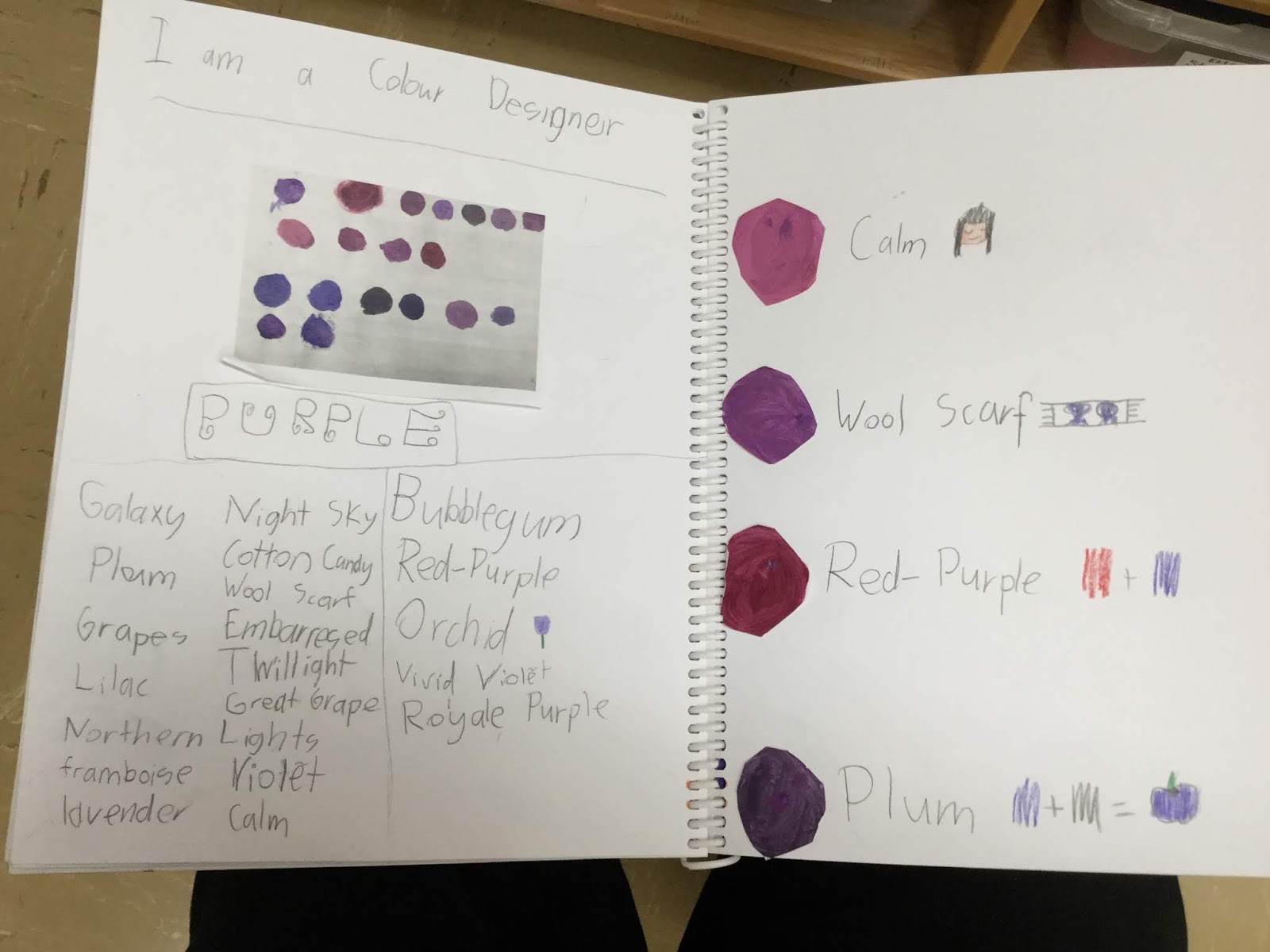
We Are Colour Designers!
Today students were "colour designers" and created their own colour palettes like you would find in a paint store, using the colours they created last week. This task took a lot of decision making. They needed to select 4-6 harmonious colours from a large selection. They had to determine which were the best shades, they needed to choose colours of different values and ones that weren't `too' similar. Then the students arranged them from lightest to darkest and gave them interesting names. Students first brainstormed things, emotions, seasons and describing words that fit their chosen colour. Many students felt that green and blue made them feel calm. A lot of student felt red was an intense, exciting and sometimes angry colour (someone noted that that is probably why we name the "red zone" the way we do!) . Many children practiced using alliteration (both words starting with same letter....ie. Soothing Seas or Radical Ruby) and most added some descriptive words or action words.
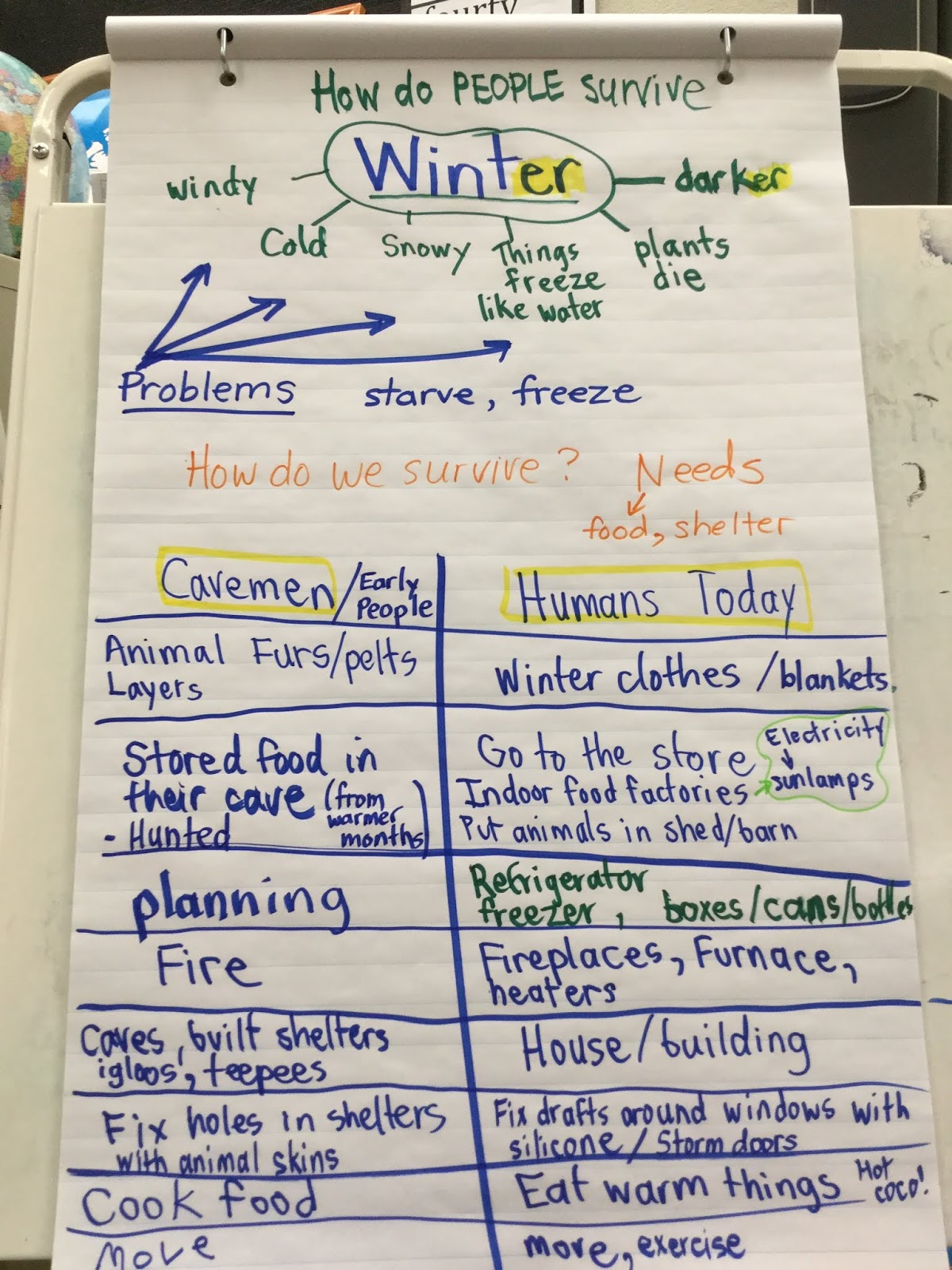
This afternoon we explored how humans survive the colder, darker weather as winter approaches. Children brainstormed in small groups, we looked at pictures and we compared strategies of Early People and Modern People in a T-chart.
At home: Talk with your child
Find out how your house is kept warm in winter. Look at the furnace. How does the heat get distributed around the house? Does it have insulation? Do you weather proof the windows? Do you have storm doors? A fireplace? Do you used different bedclothes and pjs in the winter?
How do you get food in winter? Do you store garden food in a freezer? Do you have cans and boxes of non-perishables? Look in your fridge at produce. See if any of your food comes from places that have warmer climates. We predicted that people will find food like spinach, strawberries, bananas and oranges have labels that say product of California, Mexico or other warmer countries. See if you have any food that is made here in a hydroponic factory.
A possible conversation starter:
https://www.cbc.ca/news/canada/calgary/grow-calgary-donations-food-vegetables-women-s-shelter-hydroponic-gardening-1.3992329
This website talks about how Grow Calgary, an organization that helps people in need, by growing food. Growing food here takes a lot of electricity to run the lamps, but saves the pollution created by transporting food long distances. Have a discussion about how we get our food!
Tuesday, November 20, 2018
Police Officer Visit
Today we had our school resource officer come to visit our classroom. He shared so much information about his job. We learned about his tools, his responsibilities, and even saw some pictures of his vehicles. The constable gave us all some homework. He asked that we all know our phone numbers and addresses by the end of the school year so if we need to call for help we can give that information to the dispatcher.
Students were very engaged in this presentation and did a fantastic job listening and asking questions. Be sure to talk to your child about his/her favourite part of the presentation.
Monday, November 19, 2018
Making a rubric
Today we finalized our writing rubric for our community helpers research reports. Students began by sorting through exemplars and determining what makes a 1-star, 2-star, 3-star, or 4-star report. From there, we developed the criteria and talked about how we can attain a specific score. Together we typed out the expectations and then posted them to match the specific exemplar. Below are pictures of the writing expectations for grade 1 and grade 2 writing by December 2018. Students will create a report and then self-assess to determine which score they would get. From here will create goals as to how to improve our writing for the next report.
Photographer in the classroom
Next week, on Thursday, November 27, there will be a CBE photographer in the school. He will be taking pictures of the Montessori materials and students working. If you would like your child to be in the photographs, which may be used for promotional purposes on the CBE website, please either print this consent form or send us an email and we will send a paper copy home with your child.
Friday, November 16, 2018
Colours- science or art?
Today we explored the blurred line between art and science as we became colour designers. After looking at the amazing variety of colours on a paint store website, we determined that each hue on the colour wheel can be blended with each other and mixed with white and black to create endless variations. When examining the blue palette, we saw dark blues, light blues, greeny-blues, purply-blues, grey blues....and what was better were the creative names each of these colours had...Sea Breeze, Saphire Dream, Summer Sky and more.
Being colour designers, we need to use all of our scientist behaviours, especially our predicting and working carefully skills. To create the harmonious colours, we looked at our colour wheel at colours that are adjacent to each other. These "colour wheel neighbours" are called Analogous colors.
Each student picked a dominant colour and used black, white and its neighbours to experiment, test and design a family of colours. We heard lots of questioning during this activity:
"What if I had white and black?"
"How can I make it lighter?'
"Why did it turn green?"
"I need to figure of what to add to make it like an emerald!"
"What happens if I....?
Next week, the student will judge which are their best colours and will name them.
We quickly talked about ways to TRANSLATE a simple pattern. (Translate, made the same pattern core with different attributes). We determined that AB patterns are the simplest patterns but one of the most common! (left-right of walking, windshield wipers wiping, nodding yes, shaking no...AB patterns are everywhere). We took a single manipluative, the toothpick, to explore ways to make this pattern in different ways. Children were creative thinking of ways to "change" a toothpick so it could be represented as both the A and B in this pattern.
Thursday, November 15, 2018
Asking good questions
Today we worked with our friends in Room 3. We had a class discussion about police officers and brainstormed questions we have for this community helper. Next week we will have a police officer visit our classroom to share about his job and why it is important to our community. During work period today, students wrote down questions they want to ask the police officer when he comes next week.
We had a very productive day during work period and everyone was on task, working through language, math, word work, STEM and writing choices.
Subscribe to:
Posts (Atom)
-
Today we finished building our community. Students thought of many small details to add - fire hydrants, tree, bushes, bike racks, cars, et...
-
We have started into our science exploration of liquids. We kicked off our first day with an exploration of water...
-
This week, as part of our STEM activity, students are exploring a variety of materials to build a bridge. Next week, we'll use the kno...