Friday, March 13, 2020

Landmarks in Calgary


Today we talked about how our houses and communities are within the city of Calgary.  We discussed how a city was different from a neighbourhood.  Then we talked about some of the places that make Calgary unique.  Most cities have lots of big buildings, stores, universities, parks and stadiums.  We talked about what a landmark was.  A place that is easily recognizable and helps us know where we are.  We imagined Calgary and its landmarks, discussed them and looked at many pictures.  Talk about some Calgarian landmarks with your child. 

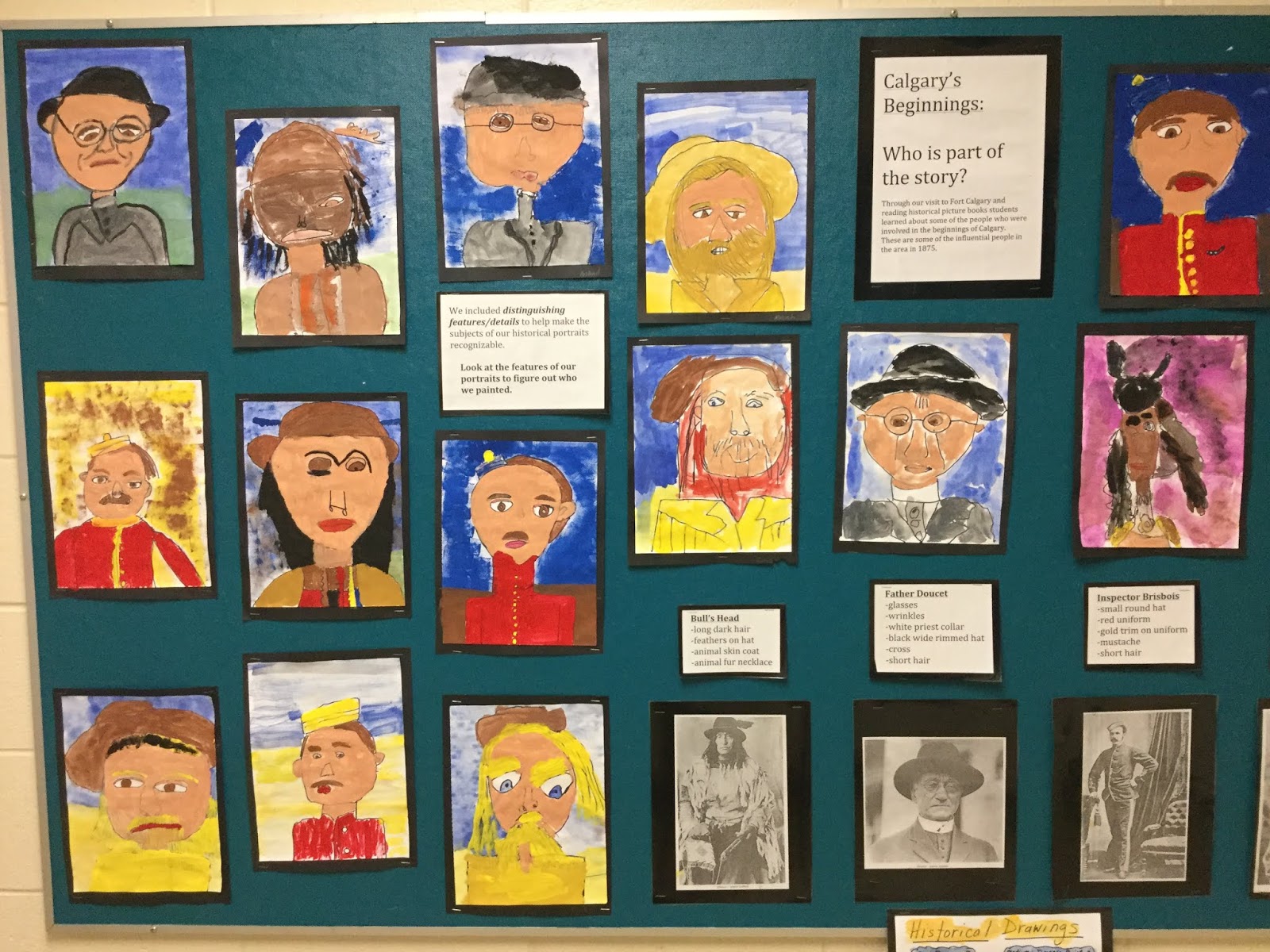
Since we are not having parents visit the school for interviews, here is the amazing art the children did for our Social Unit on Calgary's past.  


Thursday, March 12, 2020

Read to Someone


Students in grade 1 and 2 are constantly developing their reading skills. Read to Someone is an activity that students take part in every day. This involves sitting with a partner and quietly reading aloud their books that are the just right level. This activity helps students develop their fluency skills and their comprehension skills. At home, you can help develop these skills by reading aloud to your child and having them read aloud to you. It's also important that you're talking about books: retell stories, make personal connections, talk about the characters, anything else you can think about to allow your child to develop a deeper understanding of the books you read together.

Wednesday, March 11, 2020

Basic Facts Assessment- FROM Last week!

Oops, this did not publish last Wednesday.  Better late than never.

The children brought home a basic facts assessment they did last week.

If it looks like a rainbow, the kids were testing out a strategy.  We don't use the same strategy for all facts.  If the child knows their facts well, they started at the top left corner and answered the questions down the row.  HOWEVER, we discussed that if we come across a fact we don't know....we did not want to get struck.   (note parents: we should not be giving kids questions to practice if they do not have a strategy to solve it.  Practice the facts they know a strategy for.  We do not want kids practicing adding on large numbers).

This is a common test taking skill.  When stuck, kids practiced looking for facts groups they KNOW and are confident with.  Most kids first looked for adding 0 facts.  ie.  0+4=, or 8+0=.  They identified (by colouring them a particular colour) and then solved all of these facts. Then they thought of another strategy family they knew well like: COUNTING ON strategy.  It is only efficient to count on 1 or 2, so kids coloured +1 and +2 facts a different colour. ie. 5+2=, 1+7=

Some kids just coloured everything pretty randomly, but they begun to think about looking for facts in fact strategy families.....
others include:
-doubles,
-doubles +1. (or neighbour numbers)
-make 10 facts (also known as friendly facts 3+7, or 8+2)
-add 9 facts

After doing the ones they knew well, kids could see which facts they didn't know.  Kids looked at their tests, and identified in small groups what strategies they need to work on next.

Many kids found adding 7 and 8 questions hard, so today we looked at how MAKE TEN facts can help.

If we know 7+3=10 ...then 7+4=11.   because the four can be decomposed to make 3 and 1     7+(3+1)

We also explored open ended math questions where we could apply our basic facts:


TODAY, we looked at strategies for subtraction word problems.  We looked for key phrases to help use decide if it was an addition or subtraction question.   Ie.  How many left?  

Parsa used "think addition to solve subtraction" as a strategy.

Anhad used a numberline strategy

Nowellia used a regrouping strategy

We had a great time doing our felt art with Leah.  Our school art is going to be beautiful. Ask your child what they worked on. 


Tuesday, March 10, 2020

Stories are coming home today


We have been working on story telling. This process is very guided by the teachers. We go through step by step, talking about characters, setting, problems that the characters have to solve, attempts to solve the problem and a solution. Students shared ideas with partners and teachers and then did the writing. This one story has taken us 2 weeks to write. We worked through the editing process last week and then finally shared our stories to our peers and buddies. The stories are now coming home. Please celebrate your child's success, we worked very hard on these.
We are now starting our second story, which should be ready to share next week at conferences.

Tuesday, March 3, 2020

Learning about WHERE?

We looked at maps today and talked about how a compass rose can help use with describing a

location or directions. 
We will be talking about our communities tomorrow.  Does your child know which community they live in?  Our school is located in Brentwood.  (Did you know most of the streets in Brentwood start with a "B"?  The streets in neighbouring Charleswood mostly start with "CH".  Does your street name and community match?


Monday, March 2, 2020

I can compare and measure the strength of magnets


Today we explored more about magnets. We talked about the strength of different types of magnets and how the size sometimes impacts the strength of the magnetic pull. Student were real scientists and made predictions, then tested their predictions as to which magnets would be the strongest. We did multiple trials to ensure accuracy of our results.
As part of work period this week, students will explore more magnets and see which are the strongest.

Friday, February 28, 2020

what does home mean?

In Social Studies, we need to understand both people and places.  In our journey to learn about our personal stories and our city’s story, we need to understand the places that are important.  Today we delved into a big idea about place.  We asked:  

What does HOME mean?  When students were asked to imagine home, this is what they drew. 


Does home = house?   After looking at provocations like (maps, artifacts, photos) and having discussions, we decided that home could mean the structure we live in, but it could also mean more. 

Some ideas from the beginning of our conversation:

Anhad:  Home means living happy and safe

Victor: A home can be many places or anywhere

Kinsley:  Families live in houses to keep them safe

Autumn: Home is shelter

Parsa: There are many different kinds of homes

Haruto: Home is sleeping

Natalie: Home is safe

Ethan W: My home keeps me cheerful.  It keeps my things safe

Anhad: Home is everything I need

Ella: Home is where I sleep

Rihansh: playful

Parsa: Helps keep me alive

Haruto: Helps keep me cozy

Summer: It keeps me safe

Briaunna: A place you can stay warm

Anhad:  My home is Fort McMurray and Calgary.

Kinsley:  CJP is my home

Can home be a house, a community, a school, a city, a country? 

Kids mentioned that their home made them feel:
SAFE    FAMILIAR    COMFORTABLE     SUPPORTED

We thought about when we are away, what do we miss.  What are we homesick for?

Mrs. Wacker has lived in over 15 houses, in 5 different provinces and a tent in the wilderness for many summers.  Where or what is my home? 

How is my culture, language and hobbies connected to my sense of home.


We looked at Mrs. Wacker’s nesting boxes.  They show that Canada a part of the world.  Within Canada, there are provinces like Alberta.  Within Alberta, there are cities, like Calgary.  Within Calgary, there are many communities like Brentwood and Ranchlands.  These communities are filled with homes and families.